Showing posts with label Hong Kong. Show all posts

Monday, 27 April 2009

Your Japanese word of the week is...

"shashin" 写真, which means photograph. I figured since people might not be interested in reading tons and tons about my (supposed) insights on my trip, telling it in the form of pictures would be the next best thing. Plus, it's just easier to take it all in quickly with pictures than it is with pages of text.... shall we??

April 13, 2009 - Day 1 - Still in Hong Kong

Some offerings to the Tian Tan Buddha.

I find this picture very representative of Hong Kong. It's a tiny, resource-limited island that somehow manages to be completely filled to the brim with people through its original success as a trading port...

Yes, let's all do our part to increase global warming!

April 14, 2009 - Day 2 - Nanning via Shenzhen

Shenzhen is a city in China right across the water from Hong Kong. Interestingly, Hong Kong's rather unique relationship with China (a sovereign yet highly independent territory) means it's much cheaper to take an extra two hours to cross into Shenzhen and fly from there, as opposed to flying from Hong Kong. Of course, this same unique relationship means crossing between Hong Kong and China is like entering a separate country, despite the fact that you aren't...

As the plane flew over Nanning, I took note of massive multi-lane highways carving up the vast plains of farmland, the former having risen from the past 50 years of Nanning's industrial growth and China's growth overall.
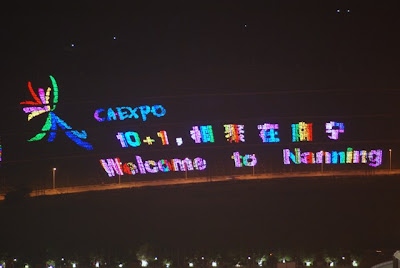
What does any city known for its lush vegetation and surrounding agricultural area need?? A giant light board, of course...

Wheeee!! No seriously, laws or common sense don't seem to exist here. Four people on one scooter? Three wide on a two lane road? Passing on the hard shoulder? Passing cops at 50kmh over the limit? Daily occurrences...

You might notice the slight haze in the "Welcome to Nanning" picture. China is indeed enveloped in a fog of pollution, even in the country side. But it does make the sunset awfully red... pros and cons I guess...

Many of the Chinese are newly wealthy. New-money people like to make it known they have new money, thus flashy and ostentatious things are quite popular. A fully light highway cloverleaf is the municipal equivalent of a diamond encrusted Rolex... But it does make the night view very interesting.

How'd they fold it so small??

April 15, 2009 - Day 3 - Detian Waterfalls, some rock garden

This is more like it. Only 20 minutes outside of the city and the the scenery changes drastically. Farmers trundle down the road in their tractors, cowpies lie in the middle of the road, people sit outside their house without a care in the world... It's hard to imagine I'm in one of the world's richest countries with the fastest growing economy. I quite like it. Until the satellite dishes and cell phones burst my bubble...

Interestingly, seeing all these people was at first pleasingly peaceful, functional, and simple. But in the midst of the cell phones, radar speed cameras (seriously), and tourists (me included), it ends up looking backward, rundown, and poor. Unfortunate what the technological perspective can do to what is otherwise a perfectly pleasant, quiet way of life...

The Detian Waterfalls. It's much more impressive during the rainy summer season with lots more water, but as you saw in the preview, it's an attractive place nonetheless. This area of China is interesting in that it's mostly flat but mountains shoot up nearly vertically, resulting not in rolling hills, but massive spikes all across the land.

Just behind the waterfall and a small hike up is the border to Vietnam, which anyone can cross freely. We wandered 10ft into Vietnam and found a gigantic plateau market hocking various (typical) tourist wares. Y'know, just in case you ran out of CK One, combs or cigarettes on your way up...

Unfortunately, the name of this rock garden place escapes me. It basically had lots of various natural rock formations that they gave creative names to. The centre of the park had a more "produced" garden that includes this path.

Why thank you, I will.

Continued in Part 2.

Monday, 20 April 2009

Your Japanese word of the week is...

"hinomaru" 日の丸. "hi" represents day (of the month, of the week) or sun while "maru" means circle. Some people even use "maru" while reading the number 0.

Together, however, "hinomaru" means something much stronger to the Japanese- the Rising Sun. The same Rising Sun found on the Japanese flag.

Having been in Hong Kong and China for the past three weeks, I wasn't sure how long it would be before I could spot the Japanese-ness as I flew home. But just before taking off, I looked out the window of my JAL 747 and saw the big hinomaru painted on top of the wing (for some reason, the first thing I thought about was the Mitsubishi Zero Fighter, but I don't know why...). So I guess that makes the Rising Sun the first real Japanese-y thing I saw on my way back. Well, that and the Japanese people in the airplane, computer animated safety video, and Japanese newpapers they were handing out....

Anyways, for my last week in Hong Kong, I headed off into China (and 20ft into Vietnam!) for an eye-opening trip. I'm still putting together all the bits and pieces but here's a preview of what's to come.

The Tian Tan Buddha atop Ngong Ping 360 in Lantau Island, Hong Kong.

The Detian Waterfalls right on the Sino-Vietnam border.

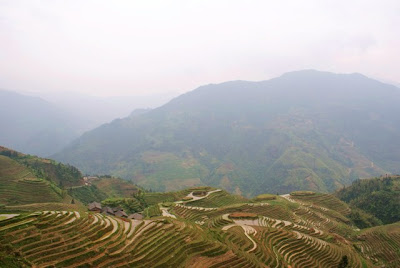
The terraced rice fields of Longji, about 100km from Guilin.

Dog..... well, people (and animals) live in mountain-top villages in Longji. I just like the picture though...

Check back soon for more...

Tuesday, 7 April 2009

Part 2...

Yesterday, I went back to the Hong Kong Museum of Art since my aunt hadn't gone so I had a chance to grab my camera and take some better photos as well as read more about some of the displays there.

Despite still having lots of people riding on trains, the feel is vastly different from Tokyo...

We started the day with a walk around Wan Chai, where you'll find the Hong Kong Convention and Exhibition Centre. The interesting thing about this building is that it's actually built, like lots of Hong Kong including the airport, on "reclaimed" land (ie- filling the sea with dirt to make a new landmass) and is connected by a short bridge. When they wanted to expand the building, the government wouldn't let them fill in the area the bridge was on, since excessive reclamation would turn Victoria Harbour into a puddle. So, they planted giant metal beams into the ocean floor and are now building the entire Exhibition Centre extension on steel supports. And all the while not "filling in the ocean". Sneaky...

The Convention Centre is the low, arched building in the foreground.

After that, it was a short ferry ride across the water to Tsim Sha Tsui to the museum. Having more time to browse, I found out a bit more about some of the displays I took pictures of.

These are the museum-founder pillows I was telling you about.... they're slightly creepy but popular (despite the lack of people in the shot =P )...

As it turns out, popular isn't the right word..... more like infamous, since nobody likes him (his main job is that of a politician). And what better way than show that than to turn him into a stuff doll?? heh...

Four caricatures found in the fine art section.

A nice minimalistic, almost cartoony painting of the 8 Eccentrics of Yangzhou.

I didn't realise this the first time I went, but the coffin-bed I took a picture of is actually connected to a display on the opposite end of the exhibit. The artist commented on the environmental (and, I suppose, metaphorical) unfriendliness of coffins being one-use and designed this. Made out of an old crate, he says he can use it as a furniture for 30 years and, when he passes away, it becomes a coffin holding all his memories. Special thanks to my aunt for modelling the sofa-table-coffin-bed...

And having had dinner near the harbour, I went back to see the lights....

Monday, 6 April 2009

Your Japanese word of the week is...

"jidai" 時代 which means "(time) period" or "era". It also means the same in Chinese, although it's read differently (si doi, in Cantonese). While it's most often refers to eras in history, it can be used to refer to any period of time- "These young whippersnappers these days, no respect at all! It really is an end of an era."

And while it doesn't directly refer to generations (that's a different word), you could use it to mention different decades people have lived through. Much like the decades I heard about from my grandmother and grandfather when I met them for lunch a few days ago. I was especially happy to see my grandpa again partly because I haven't seen him in a long time (since 2003 I believe...) but more so because he seemed more alert and stronger than I last saw him, which is always good.

More to the point, the reason "jidai" is the word of the week is because today I took a browse through the Hong Kong Museum of Art. Interestingly, I pretty much ended up in the museum by accident as, seeing I had a few hours to kill, I picked a random train station and upon exiting, a quick glance at the map directory pointed to this and the Hong Kong Space Museum in Tsim Sha Tsui.

To get the bad part with out of the way, despite costing a meagre $10HKD (a touch more than $1.50 CAD), the Space Museum wasn't that great. While it does have lots of bits and pieces of information about astronomy, space research, and space exploration, it didn't amount to much more than a well researched and comprehensive display of pictures and captions.

The Museum of Art, however, was much better. Even with its two separate Special Exhibits under renovation, the other main exhibits, including a modern art exhibit with local Hong Kong artists and a huge range of antiques and fine art from various Chinese dynasties, were great. And it also costed $10HKD.


This display is essentially a coffin-sized crate padded like a bed. A sign encouraged people to lie inside it for a nice "sleep". It was surprisingly comfy...

While red, white, and blue are typically associated with America (or France, I suppose), the "red-white-blue" canvas bags are one of the most recognizable symbols of Hong Kong. This table and backpack is matched with another exhibit outside of the room of a couch and mini-fridge, also fashioned out of the iconic fabric.

Interestingly, next to the display outside are two couches with life-size stuffed caricatures of the museum director. A video suggests giving the stuffed dolls a hug and recommends a short nap with one of the dolls to help you explore your dreams...

This really neat display is essentially an spectrum analyzer reading of Beethoven's Symphony No. 5. What you see are basically the physically representation of the peaks of various frequencies at each beat of the most well known part of the piece (the beginning), mounted to a wall. Obviously few people see music in the form of wave frequencies, but it made for an interesting art piece nonetheless.


In the antiques section, these monochrome Ming pottery examples really stole the show for me. The exhibits covered the entire range of pottery from various Chinese dynasties and while the very detailed, very intricate pottery that Chinese culture is known for were present, these monochrome ones stood out, not in the least because of their stark contrast to the more well-known (or perhaps best known) blue-on-white porcelain also from the Ming dynasty.

I particularly liked these because they looked minimalist and modern, like they'd be right at home on an Ikea shelf. Even the colour (if they were indeed such bright hues), are trendy. But the absolute best part is that really subtle and elaborate designs are engraved into the porcelain. You can't see it until you're up close (and you can barely see it in the pictures), but these simple looking bowls and cups are actually really elegant once you put some time into examining them. I like that...

However, the neatest part of the entire museum was a little area of 15 paintings in the fine art section. Titled "One Painting - One Story", each classic painting was numbered and visitors were encouraged to write a short 80 word explanation about what they thought a certain painting represented. The stories were submitted and then posted under their respective painting.

Take the above painting for example. I overheard a 6-year old future museum curator explain it as:

"One day, everyone got on a bus to go pick up their kids. But they were all annoyed because the bus was going really slow. They all said, `Why is the bus going SO slow?`. Then the bus driver said, `Because there's a cow walking across the street.` Then everyone said, `Why are there so many wheels?` And the bus driver sai-"

Then his mom said they ran out of space on the paper...

Here's one final story. I actually took a picture of the paper so what follows is a direct transcription:

"There is once a monk called Chris, who always have illosions. He once have a illousion about his Friend, Domini Lau betray him. Of course, it was a illousion but Chris thought it was real, and balled his friend. But this is not the worse one. One day Chris decided to go camping. he walked up a mountain and went to the top. There's a cliff. Chris thought there was a door. He made a 大 position and thought he opened the door. He thought he saw Issac's stove. He jump and bow. But instead he fell down the cliff. He's dead. So the illousion guy was gone.

By Issac"

I love art... =P

Thursday, 2 April 2009

Your Japanese word of the week is...

"hisashiburi" 久しぶり which translates to "after a long time". It's heard most often when you see someone again after a long time and basically means "It's been a while/Long time no see". For me it applies to my aunt, cousin, and the general country of Hong Kong, where I'm staying from April 1-19.

In truth, when I was getting ready to come here, I wasn't really expecting much. It's not my first time here and there are lots of parallels to draw between HK and Tokyo, so it couldn't be that hard to adjust, right? But, as I've found in one simple day out, HK and Tokyo are vastly different despite similar outward characteristics like lots of people in a small place, lots of tall but narrow buildings, and lots of taxis (below right).

The biggest thing is simply that while Japan always feels like a country where the image and the reality can (and are) quite different, Hong Kong has a distinctly "straight-forward" feel to it. People certainly aren't as courteous be it in shops, restaurants, or in the street. But having seen my share of aggressive or gossipy Japanese people beneath the image, seeing people in HK simply just being who they are is..... well...... not good, but..... refreshingly honest, let's say.

The city itself looks like that too. Each of Tokyo's areas look as they should whether it's a high-tech business hub or a rustic area surrounding a temple. On the other hand, HK just looks like it was built as is, on whatever budget the builder could afford, and not fixed til it broke. Lots of buildings darked by age sit right next to (or on top of) big office towers while street vendors sell their wares in stalls/shacks.

Even the fashion sense here is slightly different. People somehow look slightly less trendy, as if they saved a dime here or there whenever they could while many Japanese look like they subsisted on cup-noodles just to buy real things at real prices. As I mentioned before, there's a very real sense of honest pragmatism here...

Of course, I promptly went out shopped amongst the pragmatic vendors. There's lots of great deals to be had considering everything is made in China and those factories seem to have no qualms about making an extra few "samples" to ship over. Fakes can still be found but I have honestly seen things for sale in Japan (an Edwin messenger bag, for example) sold here at half price.

Shopping aside, it's been great just being here spending time with my aunt and cousin. And their absolutely insane Pomeranian, Lola (left). And on Saturday I'm going to see my grandpa, which I'm excited about. Oh, and getting my Chinese back up to speed of course =P......