
 A short ride on the tram from Hiroshima Station drops you off right at the entrance to Peace Park and right at the tram-side entrance is the view of the Genbaku-dome, or the Atomic Bomb Dome. This was one of the few structures that still stood after the bombing and is the only structure that remains to this day. It originally served as the Prefectural Industrial Promotion Hall and now serves as a UNESCO World Heritage Site and a timely reminder of what happened some 60 years ago.
 The park itself is really rather peaceful (no pun intended) and it does a good job of isolating the city's noise as well as feeling open despite the flocks of tourists and Hiroshima citizens (Hiroshimians?? Hiroshimites?? heh) who relax here. I particularly like the fact that, because of the park's history, it seems to exude a subtle yet strong sombre feel to it and everything around it quiets down as if in reflective contemplation- some people even take up activities such as painting or sketching the dome (above).
 This is the statue at the Monument for Teachers and Students of Elementary Schools. That is, teachers and students affected by the bombing. Notice the huge drapes of folded origami cranes dedicated to one Sadako Sasaki, more famously known as the little girl who believed folding 1000 paper cranes would cure her radiation-induced leukemia. Some of her original cranes can be found in the Peace Museum and other cranes can be found all over the park, especially at the statue dedicated to Sadako.
 Above is the Memorial Cenotaph. It houses the names of every person who perished the day of the bombing and lines up directly with both the Peace Flame (T-shaped object in the mid-ground) and the Dome in the back. The Peace Flame has burnt continuously since 1964 and will do so until all the world's nuclear weapons are disposed of.
 To the right of the Memorial Cenotaph is this, the Hiroshima National Peace Memorial Hall for the Atomic Bomb Victims. Both outside and inside (seen above) contain a fountain with a clock shape frozen at 8:15am, the time the bomb went off. The inside is particularly amazing in that, as you can see above, it contains a gigantic mural of the view of Hiroshima after the bombing. More than that, the entire mural is actually a mosaic of 140,000 individual tiles- the same as the number of victims believed to have perished by the end of 1945.

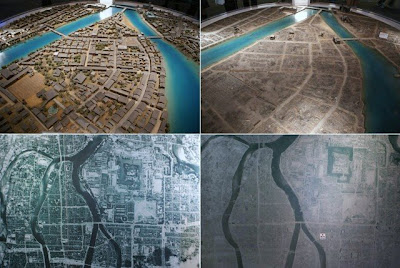 A short walk from the Memorial Hall is the Peace Memorial Museum which walks visitors through the history of Hiroshima, development of the atomic bomb, events leading up to the bombing, and the after-effects. The upper picture is a display showing the height at which the Little Boy bomb exploded (600m above ground) and the picture below are some before and after shots I put together. The left side are before the bombing, the right side being the result. The white square in the bottom right picture is the hypocentre.
 Also in the museum are various items donated by survivors or families of survivors. The helmet and tricycle above are from a man's 3 year old son who perished in the initial blast. The man buried the items with his son in his yard. Forty years later, as he transferred the remains of his son to the family grave, he donated the tricycle and helmet to the museum.
 The above photo shows a sister and brother, who were in their wooden house 1km away from the hypocentre of the blast, two months after the bombing.
 This is a slab of concrete pulled from the rubble. Note the marks found all over it. That's from shards of glass pelting its surface due of the blast. Elsewhere in the museum are various other pieces of glass surgically removed from survivors. Some of these shards were removed some 20 or 40 years after, such was the force with which the glass was driven into their bodies...

 Some shots of the aftermath. The bottom picture was taken by Yoshito Matsuhige about 2.5 hrs after the bombing took place, about 2.2km from the hypocentre. Quote:
It was an extremely sobering experience to be here, thinking about and seeing what it was like that day. A lot of the art and testimonials from survivors talk about people with their glowing red skin hanging off or victims diving into the nearby rivers in an attempt to ease the pain. Others show the effect of the black rain caused by nuclear fall out while the Memorial Hall remains ever hopeful that people will discover the names of the 70,000 yet unidentified victims to add to the 16,000 also recorded.
Of course, while the focus is on the specific event, it's not difficult to extrapolate all these effects and images to what has, is, and likely will continue happening across the globe.

Interesting, Hiroshima has thoroughly rebuilt itself and there is very little evidence of the bombing save for the cobble stones underneath the tram tracks. In fact, I'd venture to say that while Hiroshima has lots of history, travelling between these historical places offers very little; it's like "localized history". On the other hand, as you can see two pictures above, it does offer very stark contrast between the historic A-Bomb Dome and the more recent buildings nearby serving as reminder that the human spirit does not perish so easily.
Some samples of the A-Bomb Dome textures, shapes, and colours


 Continued in Part 2

 As you can see above, it's a floating gate!! Ok, it's not actually, but at high tide, it does look like it. I've always been intrigued with this particular torii and perhaps I built it up a bit too much because it was almost underwhelming when I saw it. I expected it to be super massive and hundreds of metres out in the water and perhaps radiating some kind of ethereal vermilion... and though it is very pretty and quite immense, it wasn't as big as I thought it'd be nor was it particularly far. But at least I can check it off my list haha...
 Amongst its various temples, hiking paths, and other features, Miyajima is also home to wildlife very accustomed to humans. In fact, the deer are known to follow people around and help clean the park by eating whatever they can find, including hand-out maps of the island... and what better date than going to Miyajima and sharing a tasty folded paper map??
  Right next to the O-torii is the Itsukushima Shrine. It's built on stilts, is surrounded by water at high tide, and has a three pronged pier the middle of which points directly at the gate. Being so, however, means it's inevitably crowded with people so I offer this shot of the entrance walkway instead =P...
 The banister on the staircase leading up to the Daisho-in Temple. Founded in 806 by Kobo Daishi, one of the most famous monks in Japan, it's rather important in that it's the oldest temple found in Miyajima as well as the principal temple for Shingon Buddhism.... now that I think about, I really should add a picture of the temple... I'll get to that later haha.....
 From there you can take the Daisho-in hiking course (read: stairway) to the top of Mt. Misen, the highest point on Miyajim at 535m. Interesting, it felt much higher and much steeper than Mt. Takao despite the latter being higher at 600m. Either way, climbing offers rather interesting views such as...
 ... the O-torii and...
 ... more deer!
 After you've huffed and puffed your way to the top, there's a free observation tower for you take in the sights of being on the highest peak at Miyajima. There's also exorbitantly over-priced drinks for sale but I guess nothing tastes better after a big hike than a $3 bottle of Pocari Sweat =P... In the upper picture, the tree on the right conveniently points to Hiroshima.


 I'm not really sure how I feel about such man-made nature areas, but it turns out that the park is quite old as a small plaque shows how most of the park was destroyed in the atomic bombing. And it does have some rather quaint stepping stone bridges and paths and whatnot...... it's a bit like the Sun Yat Sen Garden in Vancouver I guess....


 But that's not all. The entire Twin Ring facility actually houses myriad other things including the Honda Collection Hall with its own vehicle restoration facility (seen above), a dirt bike track, driver and rider training courses, a go-kart track, kids' rides, and the Fan Fun Lab which showcases Honda's technological advances.
 It's found in

 But even more than that, the 3 floor, 5 exhibit museum (quietly playing its generic classical music) is everything I approve of in a museum. It's comprehensive in scope, articulate in explanation, and thoughtful in organization. It's also respectful, displaying a fair number of non-Honda models that have inspired Honda's development. With few but steady visitors and a very friendly (and pretty!) all-female staff, it's a great place to slowly see how things have progressed over time, which isn't easy for museums to do.
 There was also a special exhibit called 世界のかわいい乗り物たち (sekai no kawaii nori mono tachi) which translates as "The cute vehicles of the world". Umm.... right..... I was ready to skip it but then I read Honda's translation which said "The lovely vehicles in the world". Peering into their special exhibit hall, I found out the aptly named exhibit had some of the quaintest and quirkiest old cars and bikes from around the world. I don't know where they got them (probably very generous owners loaned them to the museum), but it included very rare yet innovative cars from all corners of the globe, including a 3-wheeled Messerschmitt KR200 seen above.
 It also held some very early pieces of Honda history, including this "Auxiliary Engine" attached to a bicycle produced by Honda R&D in 1946 (above, R). Using post-war radio generator engines hooked up to bicycles, it provided the war stricken Japanese with cheap, powered transport.
 Next to that display was this, a replica 1885 Daimler Reitrad, the world's first motorcycle. Built by the company Daimler Benz (aka Mercedes-Benz), note the test model's "training wheel".
 One interesting point is that scattered across the museum are various innovative non-Honda machinery from around the world. Soichiro Honda was keen on buying some of the best machinery in the world in order to study them closely. As a result, while similar looking vehicles followed a few years later (L- 1953 Honda Benly J, R- 1950 NSU Fox), it helped Honda rapidly develop technologically.
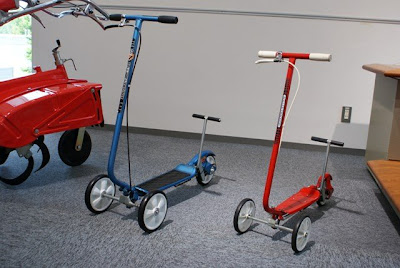 Not everything was copied though, like these 1975 Roller Through Gogo's. Note the big pedal in the back; pushing it backward would make the Gogo.... go =P
 Of course, it includes important milestones in Honda's automobile history, including a personal favourite of mine, an original 1992 NSX-R.
 And as Honda has always been heavily involved in competition, the results are seen in the dramatic difference between the high-tech 1998 Honda CBR900RR Isle of Man racer and the vintage 1960 Honda RC143, both race winners of their era.


