

First off, I do realise that I'm in none of my own photos so far and while that's partly because I'd much rather be taking the shot than being shot, I also get quite caught up in shooting whatever or wherever I am. But I suppose I should prove that I am indeed going to all these places, so this is me on the Shinkansen headed towards Nara. =P

Nara is interesting in that while it served as Japan's capital city from 710-784 and there are many temples and shrines that attest to this city's ancient importance. However, perhaps precisely because its importance was so long ago or that it was important at some point in time (or both), it's now just a giant tourist attraction. The modern city is nothing special but Nara Park, which contains quite a few of these historically important sights, is constantly filled with tourists, including various elementary and junior high kids while I was there.
 But that would sell the place short, since some of the things are still impressive. Things like the rows of lanters found all over the paths (two above) and a particularly curious shrine dedicated to... buxom-ness?? (above) I will, however, admit that after 4 days of constantly seeing shrines and temples, I'm a bit shrine-and-temple'd out. It was a bit like being back in Kyoto; all the sights are great, but they're similar enough that I felt like I'd seen it before...
 There is, of course, Todaiji Temple which is the world's largest all-wood building. It's a bit disappointing that the original Todaiji was destroy and the current one is a reconstruction that's only 2/3 the size. But it's still massive and amidst the visitors looks like a giant chocolate pastry being descended on by ants. Despite that, I was actually quite fed up with fighting through the crowds and such by 2pm so I went to check into my hostel and wound up chatting with some of the worker's and guests there.
 The girl that worked there suggested I go back to get a new perspective on Nara by watching the sunset as well as some of the lights. Seeing as there was nothing else to do in Nara (according to her, not me =P) I went. And she was right- the crowds had cleared and Nara Park turned from a buzzing playground to a quiet sanctuary. I made my way back to the Nigatsu-Do Hall, one of the highest points in the park, and watched the sunset. Surprisingly, very few people came up despite the great view (above) and the park was left open so I could explore it at night and see the lights, including:
... the various lanterns on the Nigatsu-do Hall balcony...
 ... the Five-Story Pagoda...
 ... the entrance gate to Todaiji Temple...
 ... and the Sarusawa-ike Pond near the Five-Story Pagoda.
 I think Nara really reinforces my discovery this past week- sometimes it works out great to have no plan and no watch. I have a list of things I'd like to see but I try not to confine myself to a schedule because it leaves me free to do things like go back at night and re-visit the places to get a different view. I will concede that going to any tourist attraction and complaining about other people being there is a rather ridiculous comment, but that doesn't change the fact that it can and does destroy a bit of that suspension of disbelief. However, the crowds can sometimes be a great thing in the right location, like these souvenir shops on the street leading up to the park (above).
 After a great sleep at a small but clean hostel, I headed to Nagoya. Nagoya, despite being one of the largest cities in Japan, is known for few but important things (like Nagoya Castle and Atsuta Shrine) though I found one of the greatest treasures here at two of Toyota's three museums. I first headed to Toyota's Automobile History Museum (above) and, being all history'd out, it was a refreshing sight to see.
 The museum is absolutely incredible, more so than the Honda Collection Hall. It's incredible mostly because while the Honda museum has lots of Honda with other vehicles significant to Honda's development, Toyota's museum is dedicated to the automobile itself and Toyotas only comprise of half the cars on display and, while it is Toyota's museum, it actually takes its curative role rather objectively. As such, it's a really complete collection of some of the most important, interesting, and innovative cars from... well... the very first car, the 1885 Benz Patent Motorwagen (above).
Laid out chronologically, it was careful in its layout to compare and contrast various avenues of thinking, some of which would not be out of place in the modern world. For example, they had a 1902 Cadillac Model A (red) next to a Baker Electric (blue) of the same vintage showing a gas vs electric competition that has recently been revived. In terms of alternative energy, they also had steam powered cars and (a first I've ever seen) a charcoal powered car (well, steam powered, by heated by charcoal and not gasoline).
 Other comparisons included this Ford Model T (left) and Rolls-Royce Silver Ghost (right) which showed how the Americans viewed the car as a method to move the masses while the Europeans still saw it as a pleasure for the upper class.


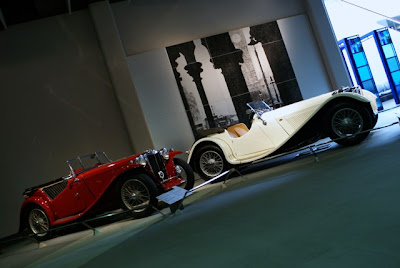 As I mentioned before, many of the most important cars in the first half of the 1900's were European and the museum shows very little bias by providing examples of these. Cars such as the 1937 MG Midget Type TA (left) and the 1937 SS Jaguar 100 (right) show the tastes and technical ability of the UK in those days.
  Taking a "break" from the cars meant visitors could see one of their temporary exhibits, this one being a look at various glass "mascots" (read: hood ornaments) made by famed French glass artist Rene Lalique. Imagine sticking one of these things on your hood =P...


 But while the Automotive History Museum was amazing, the most unexpected surprise of the trip came at the Toyota Industry and Technology Museum. Located on the grounds of Toyota's original textiles factory (Toyota was originally a textiles company and still is, amongst its other interest), it houses a collection of innovative looms invented by company founder Sakichi Toyoda as well as other weaving machinery from around the world. The above is a functional replica of the circular loom that Toyoda invented.
 The amazing part is that almost all of these machines are kept in working order and visitors are welcome to press a button and watch them run. It's fantastic to watch and hear these machines do their work and marvel at the amount of engineering that went into them to make it work. Particularly eye opening was reading some of the descriptions, which talked about ring and travelers spinning a ring frame (above) to draft and twist a rove (??). I mean, when people mention an engine has three Solex twin-barrel side draft carburetors, I get it.... but reading these loom descriptions must be what its like for people to hear me talk about cars....... so I apologize for that haha.....
 Anyway, the museum also had lots of display showing the advances in technology, from simple punch cards to the development of sensors to modern robots used in manufacturing. This display, again with a push of a button, shows a robot filling a pencil with 0.5mm lead repeatedly at high speed and with high accuracy.
 But that's not all. After this you enter the metal working exhibit which has a professional metal worker demonstrating how metal parts are cast, forged, and welded with various modern parts (mostly from cars) on display. Further on shows how the founder's son, Kiichiro Toyoda, developed and tested various metals in developing Toyota Motor Co's first car. The above picture is a diorama showing how metal panels were formed to produce the car body.


